Automation
AI Automation vs AI Agents: Which One Does Your Workflow Need?
Deterministic DAG automation vs autonomous reasoning agents. Discover when predictable execution pipelines beat agentic loops—and how hybrid architectures offer the best of both.
Y
YesPapa
By YesPapa Editorial
Published:
8 min read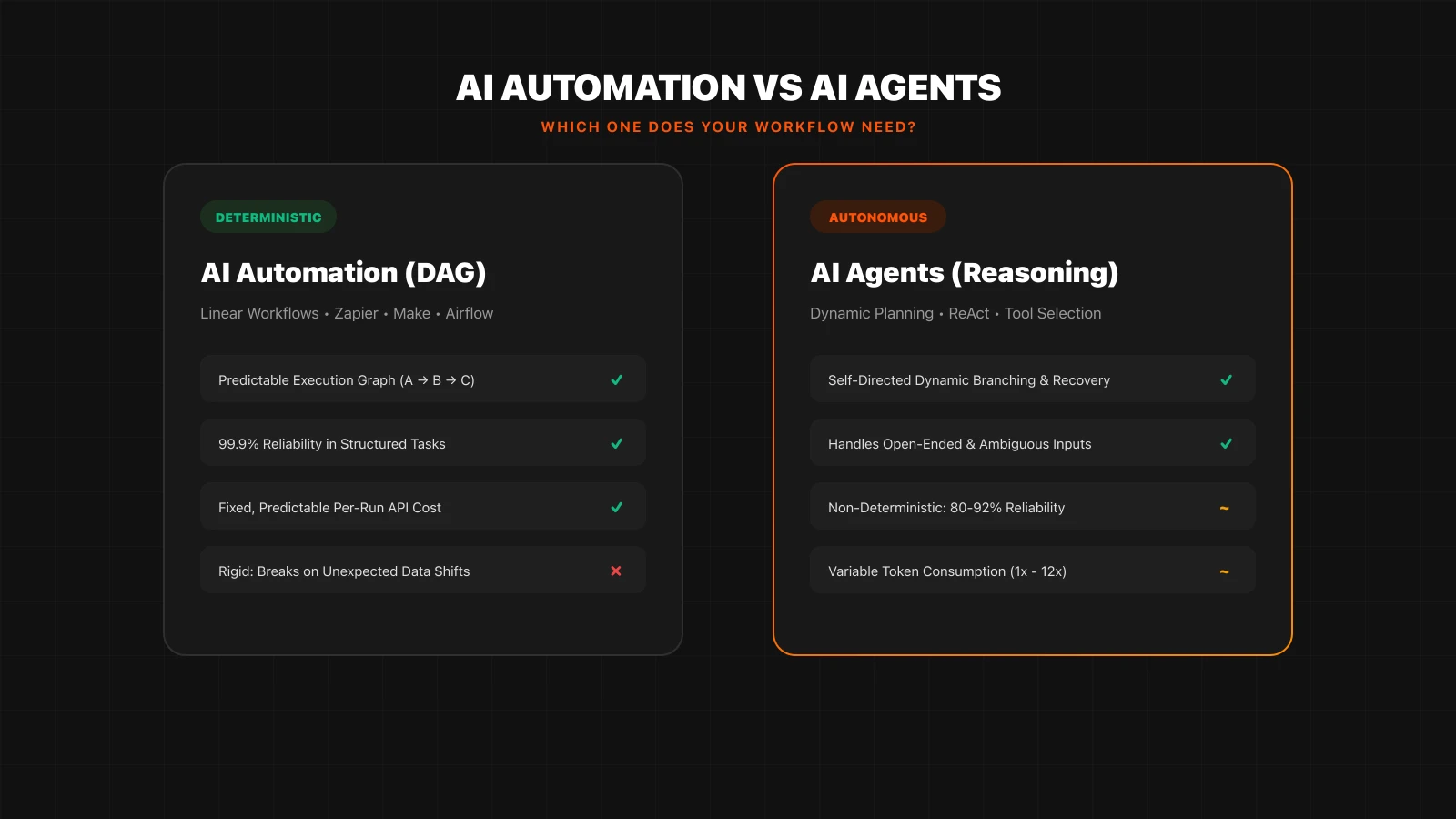
Enterprise technology roadmaps are currently dominated by an intense push toward operational automation. As corporate leaders seek to optimize operational efficiency and reduce manual processing overhead, the boundary between structured workflow automation and autonomous software agents has become dangerously muddled.
Software vendors routinely pitch autonomous agents as the universal successor to traditional automation tools. Enterprises are told that rule-based pipelines, workflow builders, and Robotic Process Automation (RPA) systems are legacy relics, soon to be replaced by self-directed models that plan and execute business processes autonomously.
In operational reality, replacing a deterministic workflow with an autonomous agent is often an expensive architectural regression. A rule-based pipeline that runs with 99.99% reliability for fractions of a cent per execution should never be replaced by a non-deterministic model that costs several cents per turn and exhibits a 5% hallucination risk.
Understanding the boundary between AI agents vs automation is critical for engineering leaders. The goal of enterprise architecture is not to deploy the maximum volume of autonomy; it is to implement the highest-reliability, lowest-cost system capable of executing a given business process safely.
Deconstructing the Two Paradigms: Deterministic vs Probabilistic
The foundational distinction between workflow automation and autonomous agents lies in how execution paths are determined:
1. Traditional and AI-Augmented Workflow Automation (Deterministic Execution)
Workflow automation is explicitly coded or configured as a directed acyclic graph (DAG). The sequence of steps is established prior to runtime by a human software engineer:
- Step 1: Ingest webhook payload from billing provider.
- Step 2: Validate customer email format using regular expressions.
- Step 3: Call an LLM endpoint with a strictly defined JSON schema to extract shipping address fields from an unstructured invoice note.
- Step 4: Write the validated record to the enterprise resource planning (ERP) database.
- Step 5: If the database write fails, retry twice with exponential backoff; if failure persists, emit an alert to an on-call Slack channel.
Notice that although Step 3 utilizes artificial intelligence for unstructured data parsing, the overall control flow is completely deterministic. The software never "decides" what step to execute next. Every edge, branch condition, retry policy, and error escalation path is fixed and audited.
2. Autonomous Agentic Workflows (Probabilistic Execution)
An autonomous agentic workflow inverts the control flow. The software is given an objective and a library of external tools, but the execution trajectory is synthesized dynamically at runtime:
- Objective: "A customer submitted an inquiry claiming an incorrect sales tax charge on invoice #4092. Reconcile the discrepancy, verify tax jurisdiction rules, and process a credit memo if verified."
- The agent inspects the goal, formulates a multi-step plan, calls a database tool to fetch invoice #4092, reads state tax tables via an API, evaluates the difference, and autonomously decides whether to call a billing adjustment endpoint.
Because the path is generated dynamically by a probabilistic model, the sequence of actions can vary between identical inputs. The system exhibits high cognitive flexibility, but introduces non-deterministic edge cases and potential failure modes.
Architectural Trade-Offs: Reliability, Cost, and Latency
Evaluating which paradigm to deploy requires examining three core technical dimensions:
1. Execution Reliability and Failure Modes
In deterministic automation, bugs are repeatable and reproducible. If an automated script fails on an edge case, an engineer inspects the error trace, writes a unit test, fixes the conditional logic, and deploys a permanent patch. Once resolved, that exact error mode will never recur.
In agentic systems, failure modes are stochastic. An agent might successfully resolve a tax reconciliation task twenty times in a row, but on the twenty-first iteration, a slight variation in the invoice wording causes the model to invoke an unexpected tool or hallucinate a nonexistent tax exemption code. Achieving 99%+ reliability in open-ended agentic loops requires extensive guardrails, multiple reflection passes, and human escalation boundaries, as analyzed in our guide on AI agents vs chatbots.
2. Operational Cost and Resource Consumption
- Deterministic Automation: Costs fractions of a cent per execution. A Python script running on AWS Lambda or Cloudflare Workers incurs negligible compute costs. Even when calling an LLM for structured field extraction, token consumption is fixed and predictable.
- Autonomous Agents: Incur compounding token expenditures. Because an agent reasons through a ReAct loop (Plan → Act → Observe → Critique), a single user request can trigger five to fifteen sequential model calls. As context windows accumulate intermediate tool outputs, each turn becomes progressively more expensive.
For a detailed financial breakdown of agentic execution economics, review our operational guide on how to build an AI agent and its real costs.
3. Execution Latency
- Deterministic Automation: Sub-second execution speeds. Database lookups, API webhooks, and regex validations execute in tens of milliseconds.
- Autonomous Agents: High, variable latency. Chained LLM inferences require sequential processing. A five-step agentic loop commonly requires twenty to ninety seconds to reach completion.
The Technical Decision Matrix
Use this structured decision framework to determine whether a given business process requires deterministic automation or an autonomous agent:
| Dimension | Choose Workflow Automation | Choose Autonomous AI Agents |
|---|---|---|
| Input Variability | Structured or predictable schemas (JSON, forms, standard PDFs) | Unstructured, open-ended, ambiguous multi-modal inputs |
| Execution Path | Fixed sequence with known conditional branches | Dynamic; cannot be mapped into a static flowchart |
| Tolerance for Error | Near zero (financial ledgers, legal filings, patient records) | Moderate to high; tasks where failure can be easily reviewed |
| Required Latency | Real-time or sub-second SLAs | Asynchronous background processing (minutes acceptable) |
| Cost Sensitivity | High-volume tasks processing millions of runs per month | High-value, low-volume complex operational tasks |
| Human Oversight | Fully automated / "lights-out" background processing | Supervised or paired with a human review modal |
Practical Scenario Analysis
To ground this architectural distinction in practical engineering choices, examine three common business workflows:
Scenario A: Employee Onboarding System Provisioning
- Recommended Approach: Deterministic Workflow Automation.
- Why: When a new employee joins an engineering organization, their required software licenses (GitHub, Slack, AWS IAM) are strictly determined by their department, role, and seniority. Using an autonomous agent to "figure out" which permissions to grant creates catastrophic security risks. A deterministic workflow (e.g., via Temporal, Zapier, or native webhooks) executes with 100% reliability, instant auditability, and zero cost.
Scenario B: Vendor Invoice Processing and Ingestion
- Recommended Approach: AI-Augmented Automation.
- Why: Ingesting PDF invoices from hundreds of different vendors involves highly variable document formats. A deterministic pipeline orchestrates the workflow (receiving the file, storing it in S3, validating tax totals), while an embedded LLM function call extracts the line-item fields into a structured JSON schema. The control flow remains deterministic, but AI provides the extraction flexibility.
Scenario C: Security Vulnerability Triage and Remediation Planning
- Recommended Approach: Autonomous AI Agent.
- Why: When a monitoring system detects an anomaly, diagnosing the issue requires open-ended technical investigation: inspecting container logs, querying dependency databases, evaluating network traffic patterns, and cross-referencing CVE vulnerability databases. An autonomous agent can plan and execute this multi-step diagnostic sequence, assembling a structured remediation proposal for the security engineering team.
The Optimal Architecture: Deterministic Skeletons with Agentic Organs
The most robust enterprise software architectures in 2026 do not choose between automation and agents as competing ideologies. Instead, they implement deterministic skeletons containing isolated agentic organs.
In this hybrid topology, the master business process is governed by a reliable, deterministic orchestration engine (such as Temporal, Inngest, or Camunda). The workflow enforces state transitions, guarantees SLA deadlines, manages transactional rollbacks, and coordinates database writes.
When the workflow encounters a complex, unstructured problem that cannot be resolved via static logic—such as interpreting a nuanced legal contract clause or formulating a multi-step debugging plan—the deterministic engine delegates the sub-task to an isolated autonomous agent running inside a containerized sandbox. Once the agent completes its analysis and returns structured output, the deterministic workflow resumes control, validating the output against strict business rules before mutating any persistent enterprise state.
By anchoring AI autonomy within deterministic workflow boundaries, businesses achieve the cognitive flexibility of modern foundation models without sacrificing the reliability, compliance, and cost predictability that enterprise operations demand.
Building something interesting with AI? [Share your story on YesPapa Insights](https://yespapa.org/brand/insights?compose=1).
Sources
- Patterns for Building Reliable AI Workflows - Anthropic Engineering
- Temporal Technologies: Architectural Principles of Deterministic Workflow Orchestration
- Enterprise Robotic Process Automation and LLM Integration Standards - Gartner Research
- Prompt Injection and Security Vulnerabilities in Autonomous Systems - OWASP Top 10 for LLM Applications
Y
Published By
YesPapa · YesPapa Editorial
YesPapa Creator Network
Launching an AI product? Find creators to promote it.
Browse vetted AI & Tech X creators, inspect audience fit, and send direct collaboration requests in minutes.
Related AI Insights
All InsightsResearch
The Hidden Costs of Running an AI Product in Production
YesPapa · Nov 17, 2026 · 13 min read
Startups
How Indie Developers Can Find Their First 100 AI Product Users
YesPapa · Nov 17, 2026 · 12 min read
Startups
AI Startup Positioning: How to Not Be "Just Another Wrapper"
YesPapa · Nov 17, 2026 · 8 min read