AI AgentsFeatured Story
AI Agents vs AI Chatbots: What's Actually Different?
Beyond conversational chat windows: how AI agents differ from chatbots across autonomous tool calling, multi-step planning, state management, and enterprise execution.
Y
YesPapa
By YesPapa Editorial
Published:
10 min read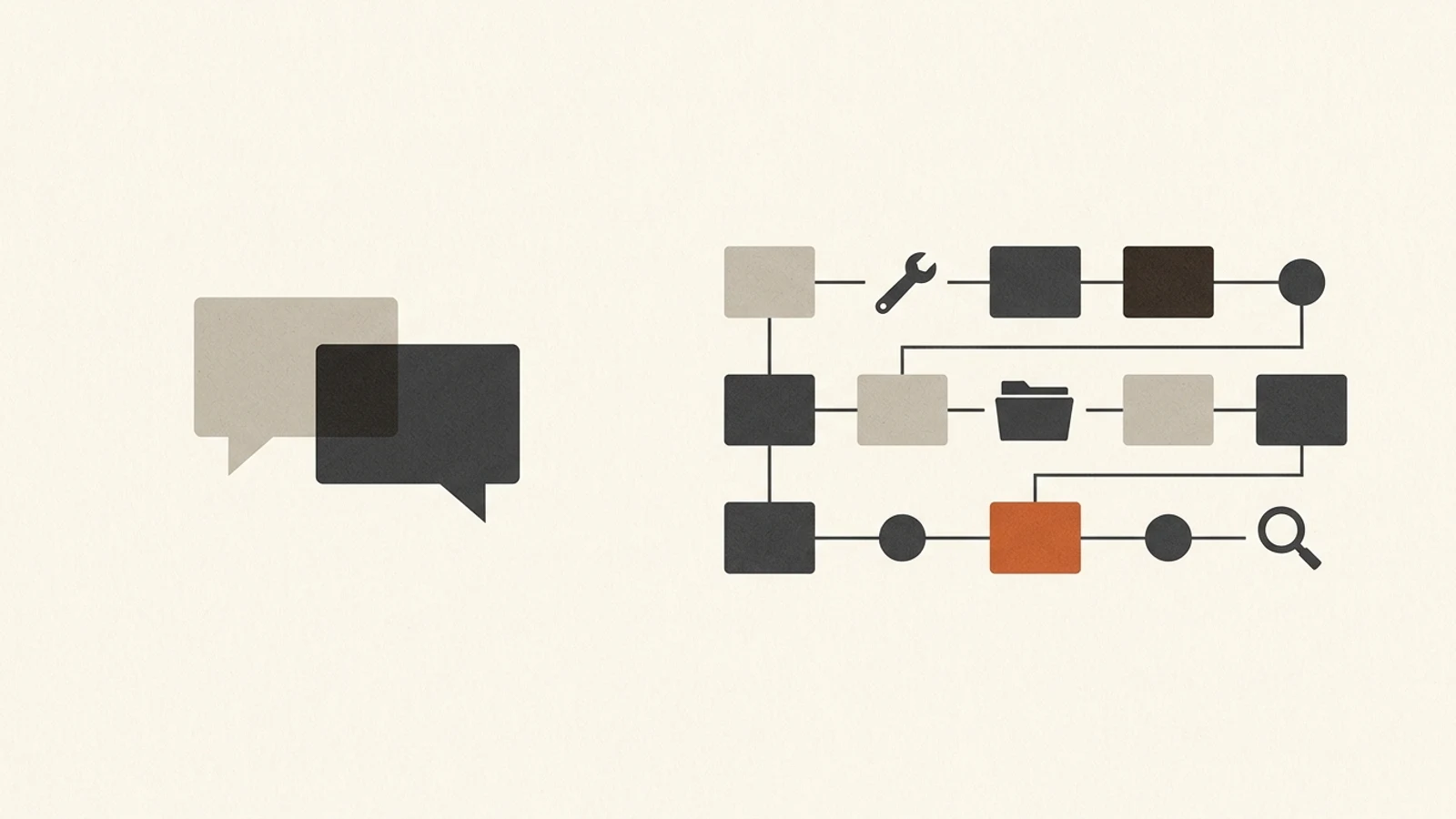
In software marketing, the boundary between an interactive chatbot and an autonomous software agent is frequently obscured by enthusiastic sales copy. Vendors routinely rebrand basic conversational text interfaces as autonomous agentic platforms simply by adding a system prompt that says "You are an autonomous executive assistant."
Underneath the marketing terminology lies a fundamental architectural divide. A chatbot is a conversational interface designed to generate textual responses to human queries within an immediate turn-by-turn feedback loop. An artificial intelligence agent is an execution loop designed to pursue an objective across time, evaluate intermediate environmental feedback, invoke external tools, mutate system state, and iterate until a predefined completion condition is satisfied.
Confusing these two paradigms leads to expensive development failures. Building an agent when a chatbot suffices introduces non-deterministic failure modes, latency penalties, and compounding API costs. Conversely, attempting to force a conversational chatbot into an operational workflow that requires multi-step state reconciliation produces frustrating user experiences and unreliable outputs. Understanding the precise architectural differences is essential for engineering teams evaluating AI agents vs chatbots.
Architectural Comparison: Direct Response vs Evaluation Loops
To understand the operational difference between these two systems, examine how each processes an incoming user intent.
A standard conversational chatbot operates on a straightforward request-response architecture:
- The client submits a user message along with recent conversation history.
- The server constructs a prompt containing system instructions, context retrieval snippets, and the user prompt.
- A large language model produces a single completion stream.
- The client renders the output to the end user.
- The runtime terminates until the user submits another turn.
In contrast, an autonomous agent executes a dynamic, stateful control loop typically structured around the ReAct (Reasoning and Acting) or plan-and-execute paradigm:
- The user specifies an objective rather than a single conversational turn (e.g., "Analyze our Postgres database for slow queries, identify missing indexes on the orders table, write an index migration script, test it on staging, and open a GitHub pull request").
- The agent breaks down the objective into a dependency graph of discrete steps.
- The system selects an external tool (such as a database client or Git API), serializes required parameters into a structured JSON schema, and invokes the tool.
- The execution environment executes the tool and returns the raw output (e.g., database execution plans or error traces) back into the agent's context window.
- The agent evaluates the environmental feedback: did the action achieve the desired state? If an error occurred, the agent replans, adjusts parameters, and re-executes.
- The loop continues autonomously until the final objective verification succeeds or a safety boundary triggers human escalation.
The key distinction is control flow: in a chatbot, the human is the control loop. In an agent, software orchestrates the control loop, consulting the model iteratively as a reasoning engine.
Tool Calling and External Integrations
Both chatbots and agents utilize model tool calling, but their integration topologies differ radically.
In modern chatbot systems, tool calling functions primarily as a context enrichment mechanism. For instance, when a customer asks a support chatbot "What is the status of order #9821?", the model emits a function call getOrderStatus(orderId: 9821). The application server executes the read-only database query, injects the return value into the context window, and prompts the model to summarize the result in polite conversational prose. The interaction is ephemeral and stateless: once the reply is displayed, no persistent background process monitors the parcel or performs subsequent actions unless the user explicitly prompts it.
In agentic systems, tool calling is mutable, chained, and open-ended. An agent equipped with file system access, terminal execution, and browser interaction can decide to execute five separate operations sequentially without user intervention:
User Goal: "Verify if user signups spiked due to the recent marketing campaign."
  │
  ├── 1. Agent calls analytics API to fetch daily active signups for the last 14 days.
  ├── 2. Agent parses response, detects 40% anomaly on Tuesday.
  ├── 3. Agent queries Stripe API to verify if signups converted to paying subscriptions.
  ├── 4. Agent queries internal logs to correlate UTM parameters with referral sources.
  └── 5. Agent drafts an executive summary table and posts it into Slack.
The agent maintains operational continuity across all five tool executions, passing intermediate state, handling unexpected schema mismatches, and retrying failed HTTP calls without halting to ask the human for permission at each step.
Memory and State Management
Memory architecture represents another sharp divergence between conversational and agentic systems.
A chatbot requires conversational memory. It retains a sliding window of recent message turns (User, Assistant, User, Assistant) so the dialogue maintains coherent pronouns and references. When the context window fills up, conversational memory simply trims older turns or summarizes preceding dialogue into a brief context block.
An agent requires multi-tier operational memory:
- Working Memory: The immediate execution scratchpad containing the active sub-task, tool invocation parameters, and immediate return codes.
- Episodic Memory: A record of previous attempts, failures, and environmental feedback encountered during the pursuit of the current objective. If a tool call returned an error two steps ago, episodic memory prevents the agent from repeating the identical failure mode.
- Semantic Memory: Long-term vector retrieval or knowledge graphs containing documentation, API schemas, and historical organizational guidelines relevant to the overarching problem.
- Entity State: Deterministic state stores (such as Redis or relational database records) that track external objects mutated during the agent's execution lifecycle.
Without rigorous state management, autonomous agents succumb to catastrophic forgetting, infinite retry loops, or state corruption across multi-hour execution runs.
Planning, Reflection, and Error Recovery
When a chatbot generates an inaccurate, hallucinated, or malformed response, it possesses no native mechanism to identify its mistake. The flawed response is immediately presented to the user. The burden of error detection falls entirely on the human interlocutor, who must issue a corrective turn ("That calculation is incorrect; try again").
Agents incorporate metacognitive reflection loops:
+-------------------------------------------------------------------------+
|                        THE AGENTIC REASONING CYCLE                      |
+-------------------------------------------------------------------------+
|                                                                         |
|   1. PLAN         --> Decompose goal into verifiable sub-tasks.         |
|   2. ACT          --> Invoke tool via structured schema.                |
|   3. OBSERVE      --> Ingest runtime stdout, stderr, or return payload. |
|   4. CRITIQUE     --> Evaluate output against expected criteria.        |
|   5. REVISE       --> Adjust trajectory or signal task completion.      |
|                                                                         |
+-------------------------------------------------------------------------+
During step 4, the agent evaluates its own output before external state is finalized. If a code-generation agent writes a Python script that fails syntax compilation, the agent's observation step captures the compiler error, updates its internal hypothesis, rewrites the code snippet, and re-runs the compiler. The human only sees the finalized, verified artifact.
Agent Autonomy and Operational Boundaries
Autonomy is not a binary toggle; it exists along a spectrum of operational authority:
- Level 1 (Direct Chat): Model answers questions; human copies and pastes text manually.
- Level 2 (Augmented Chat): Model queries read-only tools to retrieve facts; human decides all actions.
- Level 3 (Supervised Agent): Model plans a sequence of actions; human clicks "Approve" before dangerous mutations occur (e.g., sending emails or modifying database rows).
- Level 4 (Autonomous Specialist): Model operates within a tightly defined, sandboxed environment (e.g., writing and testing code in a temporary container) with automatic rollback on error.
- Level 5 (Fully Autonomous Agent): Model manages open-ended workflows across distributed systems with dynamic self-correction and financial authority.
Production architectures in 2026 operate almost exclusively between Levels 2 and 4. Level 5 autonomy remains constrained by catastrophic edge cases, prompt injection vulnerabilities, and unpredictable compounding failure rates.
Architectural Comparison Table
| Dimension | AI Chatbots | Autonomous AI Agents |
|---|---|---|
| Primary Purpose | Information delivery, text generation, and conversational interaction | Autonomous goal achievement and environmental state mutation |
| Control Flow | Synchronous, turn-based request-response | Asynchronous, cyclic execution loops (Plan → Act → Evaluate) |
| Human Role | Controls every turn; guides direction and catches errors | Defines top-level objective and sets safety boundaries |
| Tool Usage | Primarily read-only context retrieval | Read, write, execute, and state-modifying actions |
| Memory Scope | Short-term dialogue context (recent message turns) | Working scratchpad, episodic failure logs, and persistent state |
| Failure Mode | Hallucinations presented directly to user | Infinite execution loops, tool drift, and unexpected state changes |
| Latency Profile | Low (single LLM inference, 500ms – 3,000ms) | High (multi-step loops, 15 seconds – several minutes) |
| Cost Model | Linear per conversation turn | Non-linear; expands with retry count and reasoning depth |
Real-World Applications: When to Choose Each Approach
Selecting between a chatbot and an agent should be guided by the nature of the underlying operational task.
When to Build a Chatbot:
- Customer Support Front-Lines: Resolving tier-1 support inquiries by retrieving published policy documentation, answering FAQ queries, and escalating complex tickets to human staff.
- Internal Knowledge Retrieval: Enabling employees to query internal documentation, employee handbooks, and historical project wikis using natural language search.
- Content Drafting and Ideation: Providing interactive feedback during creative writing, marketing copy drafting, or code snippet brainstorming where human judgment directs every step.
When to Deploy an Autonomous Agent:
- Automated Pull Request Review and Migration: Inspecting codebase changes against static analysis rules, executing test suites in an isolated container, and generating pull requests for standard dependency updates.
- Complex Financial Reconciliation: Pulling bank transaction feeds, querying billing databases, comparing line-item discrepancies across multi-currency ledgers, and drafting accounting adjustment journals.
- Incident Triage and Diagnostics: Detecting production monitoring alerts, querying telemetry logs, isolating failing microservice pods, and assembling structured diagnostic briefs for on-call engineers.
Before deciding to deploy an autonomous agent, engineering leaders should also evaluate deterministic automation alternatives. As explored in our comparative analysis of AI automation vs autonomous agents, deterministic workflows often deliver higher reliability at a fraction of the operational cost when tasks follow well-defined procedural rules.
The Hybrid Future: Supervised Agentic Workflows
The most successful production deployments in 2026 rarely choose pure autonomy or pure chat. Instead, they implement human-in-the-loop agentic architectures.
In a supervised workflow, the agent operates autonomously across read-only exploratory phases: querying databases, identifying anomalies, gathering documentation, and planning a remediation sequence. Once the plan is formulated, the agent pauses execution and presents the structured action proposal to a human operator via an interactive conversational interface. The human inspects the diff, approves the critical state mutation, and allows the agent to execute the final step.
By pairing conversational clarity with autonomous tool execution, teams achieve the velocity benefits of agentic automation while eliminating the catastrophic risks of unmonitored software decisions.
Building something interesting with AI? [Share your story on YesPapa Insights](https://yespapa.org/brand/insights?compose=1).
Sources
- ReAct: Synergizing Reasoning and Acting in Language Models - Yao et al., Princeton University & Google Research
- Building Effective Agents - Anthropic Engineering Research
- Function Calling and Tool Use Documentation - OpenAI Developer Platform
- Model Context Protocol Specification - Anthropic Open Source Standards
Y
Published By
YesPapa · YesPapa Editorial
YesPapa Creator Network
Launching an AI product? Find creators to promote it.
Browse vetted AI & Tech X creators, inspect audience fit, and send direct collaboration requests in minutes.
Related AI Insights
All InsightsAI Agents
How to Build an AI Agent: Architecture, Tools, and Real Costs
YesPapa · Nov 17, 2026 · 8 min read
Research
The Hidden Costs of Running an AI Product in Production
YesPapa · Nov 17, 2026 · 13 min read
Startups
How Indie Developers Can Find Their First 100 AI Product Users
YesPapa · Nov 17, 2026 · 12 min read