Startups
AI Startup Positioning: How to Not Be "Just Another Wrapper"
Why thin LLM wrappers are vulnerable to platform obsolescence, and how ambitious founders build defensible value through domain workflows, proprietary context, and systems of record.
Y
YesPapa
By YesPapa Editorial
Published:
8 min read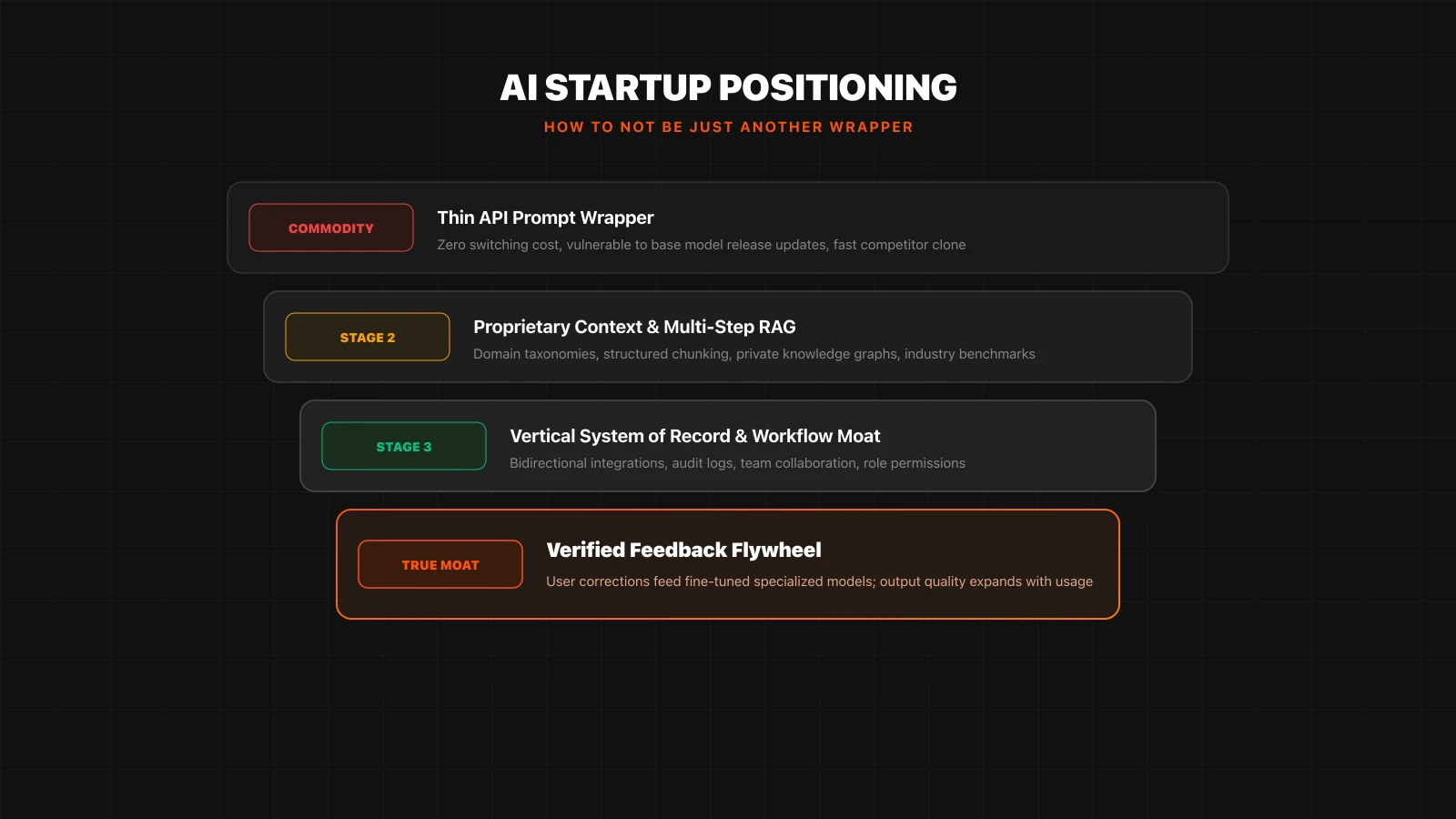
In early software incubators and investor discussions, no label is delivered with more dismissive skepticism than: "That's just a thin wrapper around OpenAI."
The skepticism is understandable. When foundation model providers release platform updates—introducing native multimodal analysis, automated reasoning loops, or integrated browser tools—hundreds of venture-backed startups built as thin convenience interfaces evaporate overnight. If an application's primary differentiation is an elaborate system prompt combined with a stylized user interface, it possesses zero structural defensibility.
Yet dismissing all applications built on top of foundation models as fragile wrappers reveals a fundamental misunderstanding of how enterprise software creates durable economic value. Every major software paradigm shift—from relational databases in the 1980s to web browsers in the 1990s and mobile cloud architectures in the 2010s—was initially criticized as a thin layer over underlying infrastructure.
The distinction between a doomed commodity wrapper and an enduring software enterprise lies entirely in AI startup positioning, domain workflow integration, and the systematic accumulation of proprietary context. This guide explores the architectural and strategic maneuvers required to build a defensible product that thrives regardless of how capable underlying foundation models become.
The Commodity Wrapper Trap: Anatomy of a Fragile Product
A product falls into the commodity wrapper trap when it exhibits three fatal characteristics:
- Horizontal Generality: Attempting to serve every professional with a generic conversational box. When you build a general-purpose tool, you compete directly with foundation model vendors whose research budgets exceed your gross revenue by orders of magnitude.
- Stateless Transient Interactions: The application retains no persistent state across user sessions. The user enters text, receives an output, copies it into their actual working environment, and closes the browser. The product functions as a transient clipboard utility rather than a mission-critical tool.
- Zero Switching Cost: If a competitor launches an identical frontend tomorrow or a user can achieve the same outcome by pasting the prompt directly into ChatGPT, customer churn will inevitably approach 100%.
When foundation model providers release API price reductions or model upgrades, commodity wrappers do not benefit; they are commoditized further as baseline expectations shift.
The Four Layers of AI Product Defensibility
To escape the wrapper stigma, founders must construct defensibility across four progressive structural layers:
+-------------------------------------------------------------------------+
|                  THE FOUR LAYERS OF AI PRODUCT DEFENSIBILITY            |
+-------------------------------------------------------------------------+
|                                                                         |
|  Layer 4: THE PROPRIETARY FEEDBACK FLYWHEEL                             |
|           --> User corrections tune domain adapters & evaluation sets.   |
|                                                                         |
|  Layer 3: THE SYSTEM OF RECORD (Workflow Integration)                   |
|           --> Historical audits, bi-directional sync, team permissions.  |
|                                                                         |
|  Layer 2: THE CONTEXT & DATA ACCUMULATION ENGINE                        |
|           --> Private vector graphs, industry taxonomies, RAG pipelines. |
|                                                                         |
|  Layer 1: THE COMMODITY FOUNDATION (Base Model API)                     |
|           --> Base LLM weights, commodity token generation.             |
|                                                                         |
+-------------------------------------------------------------------------+
Layer 1: The Commodity Foundation
At the baseline sits the foundational language model. In 2026, intelligence at this layer is an open commodity. Whether you invoke Claude 3.5 Sonnet, GPT-4o, or an open-weights Llama 3.3 model, raw token generation provides zero unique competitive advantage.
Layer 2: The Context and Data Accumulation Engine
Defensibility begins when you enrich the model's reasoning with proprietary, domain-specific contextual knowledge. This encompasses structured industry taxonomies, private enterprise databases, specialized document parsing pipelines, and complex Retrieval-Augmented Generation (RAG) graphs.
When your application processes an inquiry, it does not send a bare prompt; it dynamically injects dozens of proprietary context vectors that third-party interfaces cannot access.
Layer 3: The System of Record and Workflow Lock-In
The deepest moat in enterprise software is becoming the primary system of record for a specific business process.
Consider an AI application that reviews commercial construction submittals for building code compliance. The underlying language model performs the extraction, but the enterprise value lives in the workflow ecosystem:
- Bi-directional integrations with Procore and Autodesk Construction Cloud.
- Immutable audit logs certifying who reviewed and approved each structural modification.
- Multi-stakeholder review workflows allowing architects, structural engineers, and general contractors to resolve discrepancies collaboratively.
A construction firm will not replace this software with a generic foundation model chat window, even if the foundation model is free. The cost of abandoning the audit trails, compliance history, and team integrations far exceeds the monthly software subscription.
Layer 4: The Proprietary Feedback Flywheel
The final defensibility layer is established when ongoing user behavior continuously enhances system performance.
Every time a human expert edits an automated suggestion, accepts a correction, or flags an error, that interaction is serialized into structured evaluation datasets. These gold-standard datasets are used to fine-tune specialized domain adapters (via LoRA or DPO), creating a performance gap between your specialized application and general-purpose frontier models that widens with every active user session.
Strategic Positioning: The Power of Radical Specificity
Defensibility is as much a marketing and positioning challenge as an engineering challenge. Strong positioning shields your application from commodity comparisons.
The Contrast in Strategic Positioning:
- Weak, Fragile Positioning: "An AI writing copilot for professionals."
- Perception: A thin wrapper around standard text generation.
- Competitors: ChatGPT, Microsoft Copilot, Claude, Notion AI.
- Willingness to Pay: $10 to $20 per month; extremely high churn.
- Defensible, High-Value Positioning: "An automated underwriting memo generator for mid-market commercial equipment lenders that validates UCC filing liens."
- Perception: Mission-critical compliance infrastructure.
- Competitors: Slow manual human paralegal review, clunky legacy enterprise mainframes.
- Willingness to Pay: $2,500 to $10,000 per month; near-zero churn.
When evaluating your product positioning, ask a diagnostic question: Can an executive at your target customer understand why this product matters without using the word 'AI'?
If your entire value proposition collapses when you remove the term "artificial intelligence," you have built an algorithm demo, not a business. If your value proposition is defined by business metrics—reducing loan origination cycle times from five days to forty minutes—the product possesses durable enterprise value.
Finding this clarity requires engaging directly with prospective customers rather than relying on automated marketing funnels, as outlined in our tactical guide on how indie developers find their first 100 users.
The Five Steps to Reposition an AI Product
If your current software product suffers from high churn and sluggish adoption, execute this disciplined positioning reset:
1. Identify Your Outlier Retention Cohort
Export your user database and filter for accounts that have returned to your application consistently for thirty or more consecutive days. What specific task are they performing? What exact file formats are they uploading? What industry do they operate in? If only two such users exist, those two users hold the blueprint for your future business.
2. Eliminate Generalist Features
Ruthlessly prune settings, tangential prompt libraries, and secondary tools that cater to casual users. Every extra button that does not serve your core target persona degrades onboarding clarity and inflates your long-term maintenance overhead.
3. Speak the Customer's Native Dialect
Strip away generic software buzzwords like "supercharge," "seamless," and "intelligent." Replace them with the technical terms, compliance requirements, and regulatory standards used by practitioners in your chosen vertical. When an industry professional reads your landing page, they should instantly recognize that the product was engineered by someone who understands their daily operational reality.
4. Re-Anchor Against the Manual Default
Do not position your tool against other AI applications; position your tool against the messy, error-prone manual process your customer currently endures. Emphasize how your system eliminates tedious data entry, reduces audit risk, and integrates directly into their established toolchains.
5. Validate Positioning Through Sales Velocity
Strong positioning immediately manifests as increased sales velocity. When your positioning is clear, prospective buyers stop asking "Can it also do X?" and instead ask "How quickly can we deploy this across our team?"
Software products win in competitive markets through differentiation and focus, not through sheer feature accumulation. Before writing another line of code, clarify your positioning. As explained in our post-mortem on why AI products fail after launch, discovering a narrow, acute customer bottleneck is the only reliable foundation for lasting enterprise growth. Founders who master this discipline can build thriving software enterprises even on shoestring resources, following the blueprint outlined in launching an AI tool with no marketing budget.
Building something interesting with AI? [Share your story on YesPapa Insights](https://yespapa.org/brand/insights?compose=1).
Sources
- Obviously Awesome: How to Nail Product Positioning So Customers Get It, Buy It, Love It - April Dunford
- Positioning: The Battle for Your Mind - Al Ries and Jack Trout
- Playbook for Vertical B2B AI Software - Bessemer Venture Partners
- Finding Early Product-Market Fit in Enterprise Software - Sequoia Capital
Y
Published By
YesPapa · YesPapa Editorial
YesPapa Creator Network
Launching an AI product? Find creators to promote it.
Browse vetted AI & Tech X creators, inspect audience fit, and send direct collaboration requests in minutes.