LLMs & Models
Open Source vs Closed AI Models: What Founders Need to Know in 2026
Weighing proprietary frontier APIs against open-weight models like Llama 3.3 and DeepSeek-R1. Explore the real trade-offs between performance, GPU hosting costs, and data privacy.
Y
YesPapa
By YesPapa Editorial
Published:
8 min read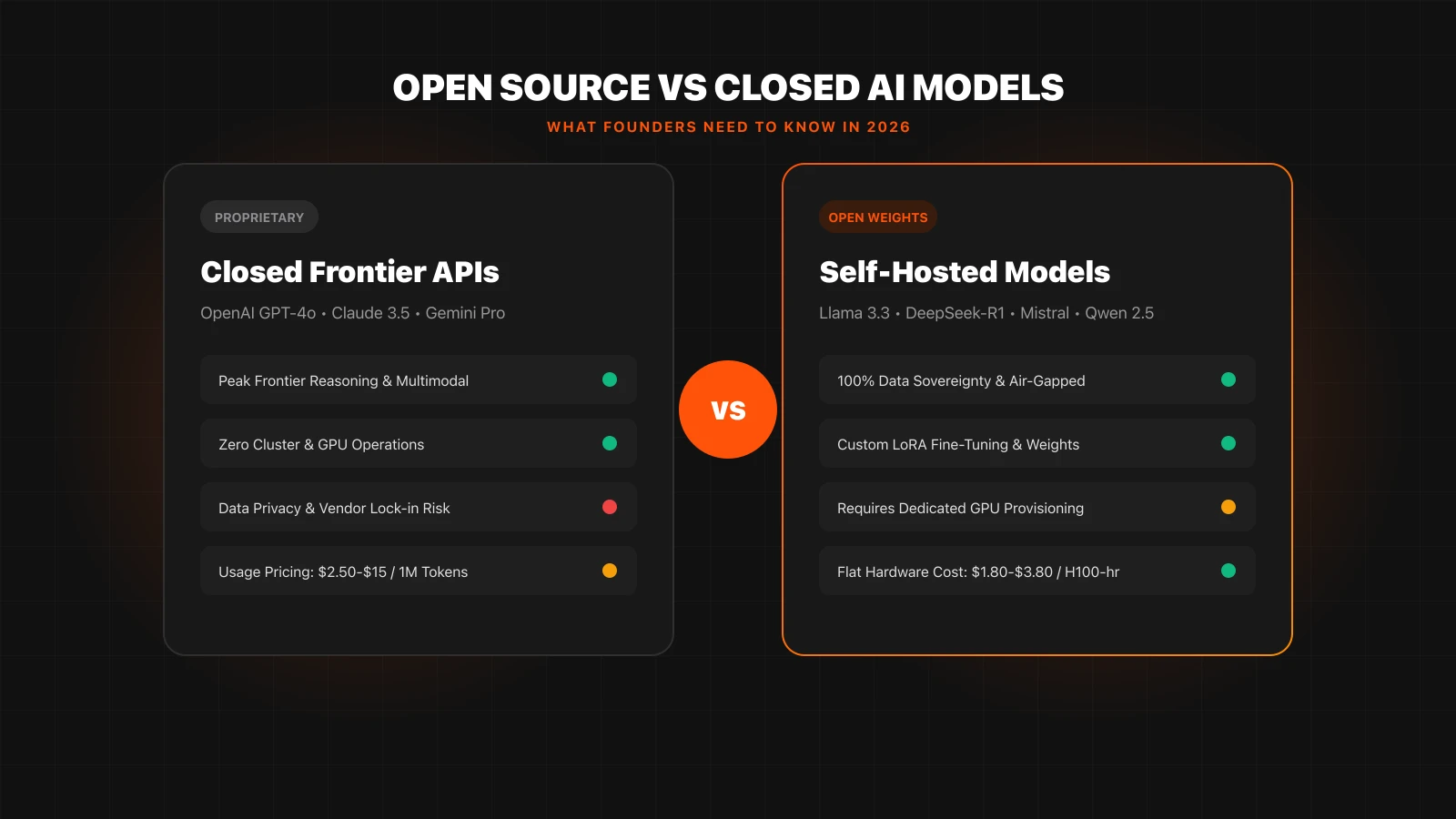
The architectural decision between building on commercial foundation model APIs versus deploying self-hosted open-weights models is frequently framed through ideological extremes. Enthusiasts of proprietary models argue that rapid frontier capability improvements render self-hosting obsolete. Advocates of decentralized software insist that relying on commercial APIs creates existential vendor lock-in that threatens software sovereignty.
For engineering teams building commercial applications, neither ideological pole reflects operational reality. The decision to choose open source vs proprietary AI models is an engineering optimization problem balancing inference latency, data sovereignty, capital expenditures, operational maintenance overhead, and capability requirements.
Understanding the true trade-offs requires cutting through marketing ambiguities, examining the formal definitions governing modern artificial intelligence licenses, and calculating the total cost of ownership across both deployment topologies.
Clarifying Terminology: Open-Weights vs Open Source AI
Before evaluating technical trade-offs, engineering leaders must understand an essential legal distinction that the tech industry routinely conflates: the difference between an open-weights model and an authentic open-source AI system.
In October 2024, the Open Source Initiative (OSI) formally released the Open Source AI Definition (OSAID) v1.0. The OSI established that for an artificial intelligence system to be certified as open source, it must guarantee four foundational freedoms—to use, study, modify, and share the system for any purpose—across all its constituent components. Crucially, this requires providing:
- Source Code: The complete software used to train, run, evaluate, and fine-tune the system under an OSI-approved license.
- Model Parameters: Unrestricted model weights and configuration hyperparameters.
- Data Provenance Information: Sufficiently detailed documentation regarding training data sources, filtering pipelines, and curation methodologies to enable a skilled practitioner to reproduce a substantially equivalent model.
Under this standard, models like Meta's Llama series are legally classified as open weights, not open source. The Llama Community License Agreement imposes explicit commercial restrictions: applications with more than 700 million monthly active users must request a special license, and using Llama model outputs to improve or train competing models is explicitly prohibited.
Conversely, models released under true permissive licenses (such as Apache 2.0 or MIT, utilized by specific releases from Mistral, Qwen, and Allen AI) grant unrestricted commercial utilization, modification, and redistribution rights. Understanding the specific license governing an open-weights model is vital before embedding it into enterprise software products.
The Hosted Proprietary Model Paradigm
Commercial API providers—primarily OpenAI, Anthropic, and Google Cloud—operate centralized inference clusters housing massive frontier models (e.g., GPT-4o, Claude 3.5 Sonnet, Gemini 1.5 Pro).
The Primary Advantages:
- Zero Infrastructure Management: Engineering teams do not configure Kubernetes clusters, provision CUDA drivers, manage GPU hardware failures, or balance vLLM or TensorRT-LLM inference runtimes. You invoke an HTTPS endpoint and receive a token stream.
- Immediate Access to Frontier Capabilities: Complex multi-modal understanding, advanced reasoning, and state-of-the-art coding abilities arrive on day one without requiring multi-million-dollar training budgets.
- Usage-Based Variable Cost: You pay exclusively for the tokens your application consumes. If traffic drops to zero over the weekend, your inference expenditure is zero dollars.
The Operational Drawbacks:
- Data Governance and Compliance Friction: Transmitting sensitive customer data across external multi-tenant infrastructure introduces severe compliance hurdles for healthcare (HIPAA), defense, financial, and European Union (GDPR) enterprise customers.
- Sudden Deprecation and Silent Drift: Foundation model providers routinely update default weight snapshots or deprecate older model versions. A prompt carefully calibrated for version X can subtly alter its output distribution when the provider rolls out an unannounced system update.
- Platform Dependency: Your core unit economics are bound to third-party pricing tiers, leaving your product vulnerable if a provider adjusts rate limits or bans specific commercial categories.
The Self-Hosted Open-Weights Paradigm
Deploying open-weights models (such as Llama 3.3 70B, DeepSeek-R1, Mistral Large, or Qwen 2.5) on private infrastructure (AWS EC2, RunPod, Lambda Labs, or on-premises GPU servers) inverts this operational dynamic.
The Primary Advantages:
- Absolute Data Sovereignty: Weights execute within an air-gapped private virtual cloud (VPC). Customer tokens never touch external third-party endpoints, simplifying SOC2, HIPAA, and ISO 27001 compliance.
- Custom Adaptability (LoRA & Direct Fine-Tuning): Teams can train Low-Rank Adaptations (LoRA) or perform full parameter fine-tuning on specialized domain datasets, achieving superior task performance on niche formats compared to generic frontier models.
- Predictable High-Volume Economics: At high token volumes (tens of millions of queries per month), dedicated GPU clusters deliver substantially lower unit costs than metered API billing.
The Operational Drawbacks:
- High Fixed Capital Expenditure: An H100 GPU instance (such as an AWS
p5.48xlargewith 8x H100 GPUs) costs between $20.00 and $35.00 per hour, generating a minimum fixed baseline cost of $14,000 to $25,000 per month regardless of whether users send requests. - Inference Engineering Overhead: Engineering teams must manage KV cache optimization, dynamic batching, speculative decoding, and model quantization (FP8, AWQ, or GPTQ) to maintain acceptable Time to First Token (TTFT) under variable concurrency.
- Hardware Scarcity: Securing multi-year reserved GPU instances from tier-1 cloud providers requires long-term capital commitments.
The Definitive Comparison: Hosted APIs vs Open Weights
| Dimension | Proprietary Frontier APIs (Claude, OpenAI) | Self-Hosted Open Weights (Llama, DeepSeek) |
|---|---|---|
| Setup Time | Minutes (generate API key, copy SDK) | Days to weeks (cluster setup, vLLM config, CI/CD) |
| Fixed Monthly Minimum | $0.00 | $1,500 – $25,000+ (reserved cloud GPU instances) |
| Breakeven Volume | Economical under 50M tokens/month | Economical above 100M tokens/month at constant load |
| Data Privacy | Subject to vendor zero-data-retention agreements | 100% private, VPC-contained, air-gapped capable |
| Fine-Tuning Scope | Limited to vendor-hosted adapters | Full parameter access, custom weights, LoRA merging |
| Latency Consistency | Variable (subject to global platform traffic spikes) | Deterministic (controlled by provisioned GPU capacity) |
| Operational Labor | Zero hardware or driver maintenance | Ongoing CUDA, driver, kernel, and inference stack tuning |
Total Cost of Ownership (TCO) Model
To understand when self-hosting becomes financially rational, evaluate the operational economics of running a B2B application processing 150 million input tokens and 30 million output tokens per month.
Scenario A: Proprietary API (Claude 3.5 Sonnet / GPT-4o Blend)
- 150M input tokens @ $3.00 / 1M = $450.00
- 30M output tokens @ $15.00 / 1M = $450.00
- Prompt caching applied to 60% of input tokens = -$243.00
- Total API Spend: $657.00 per month.
Scenario B: Dedicated 8x A100 (80GB) Cloud GPU Node
- Reserved 1-year GPU instance on RunPod / Lambda: $12.00 / hour
- Monthly instance uptime: 730 hours × $12.00 = $8,760.00.
- Machine Learning Infrastructure Engineer allocation (10 hours/month @ $150/hr): $1,500.00.
- Total Self-Hosted Spend: $10,260.00 per month.
In this scenario, self-hosting costs over fifteen times more than using commercial APIs. For an early-stage startup, self-hosting is an irresponsible allocation of scarce capital.
The Crossover Threshold:
Self-hosting becomes economically advantageous only when application query volume crosses 1.5 to 2.5 billion tokens per month, where GPU utilization exceeds 75% around the clock. Below that threshold, hosted APIs remain vastly superior on a pure unit cost basis. For a deeper breakdown of infrastructure expenditures across production systems, review our analysis of hidden costs of running an AI product in production.
The Pragmatic Hybrid Architecture
Forward-thinking software architects in 2026 rarely make a binary commitment to one paradigm. Instead, they implement an adaptive hybrid topology:
+-------------------------------------------------------------------------+
|                  THE PRAGMATIC HYBRID AI ARCHITECTURE                   |
+-------------------------------------------------------------------------+
|                                                                         |
|  Incoming User Request                                                  |
|       │                                                                 |
|       ▼                                                                 |
|  [Security & Routing Gateway]                                           |
|       │                                                                 |
|       ├── PII / Healthcare Data? ───► [Self-Hosted On-Prem Model]       |
|       │                               (Llama 3.3 70B in Private VPC)    |
|       │                                                                 |
|       ├── Complex Creative Logic? ──► [Proprietary Frontier API]       |
|       │                               (Claude 3.7 Sonnet / GPT-4o)      |
|       │                                                                 |
|       └── High-Volume Classification ► [Quantized Small Local Model]     |
|                                       (Mistral 7B / Qwen 2.5 14B)       |
|                                                                         |
+-------------------------------------------------------------------------+
By matching each operational task to the most appropriate execution environment, engineering teams protect customer data sovereignty where legally required while leveraging frontier reasoning models where cognitive complexity demands it. When building complex autonomous systems, this hybrid model provides the optimal balance of intelligence and cost, as documented in our engineering guide on building production AI agents.
Building something interesting with AI? [Share your story on YesPapa Insights](https://yespapa.org/brand/insights?compose=1).
Sources
Y
Published By
YesPapa · YesPapa Editorial
YesPapa Creator Network
Launching an AI product? Find creators to promote it.
Browse vetted AI & Tech X creators, inspect audience fit, and send direct collaboration requests in minutes.
Related AI Insights
All InsightsResearch
The Hidden Costs of Running an AI Product in Production
YesPapa · Nov 17, 2026 · 13 min read
Startups
How Indie Developers Can Find Their First 100 AI Product Users
YesPapa · Nov 17, 2026 · 12 min read
Automation
AI Automation vs AI Agents: Which One Does Your Workflow Need?
YesPapa · Nov 17, 2026 · 8 min read